
Engineering Software Skills Every Future Engineer Should Learn | Advanced Engineering Training
The engineering profession is evolving rapidly as industries embrace digital transformation, automation, artificial intelligence, and advanced manufacturing technologies. Today’s employers expect engineering graduates to possess more than theoretical knowledge—they seek professionals who can confidently use industry-standard software to solve complex engineering challenges, optimize systems, and improve operational efficiency.
According to the U.S. National Science Foundation (NSF), strengthening the engineering workforce through technical education and practical training is essential for maintaining innovation and global competitiveness. Learn more about the NSF’s engineering workforce initiatives here: https://www.nsf.gov/eng/workforce-development/.
Engineering software has become the foundation of modern industrial practice. Whether designing manufacturing systems, analyzing process performance, automating laboratory equipment, or interpreting engineering data, software proficiency enables engineers to make informed decisions with greater accuracy and speed.
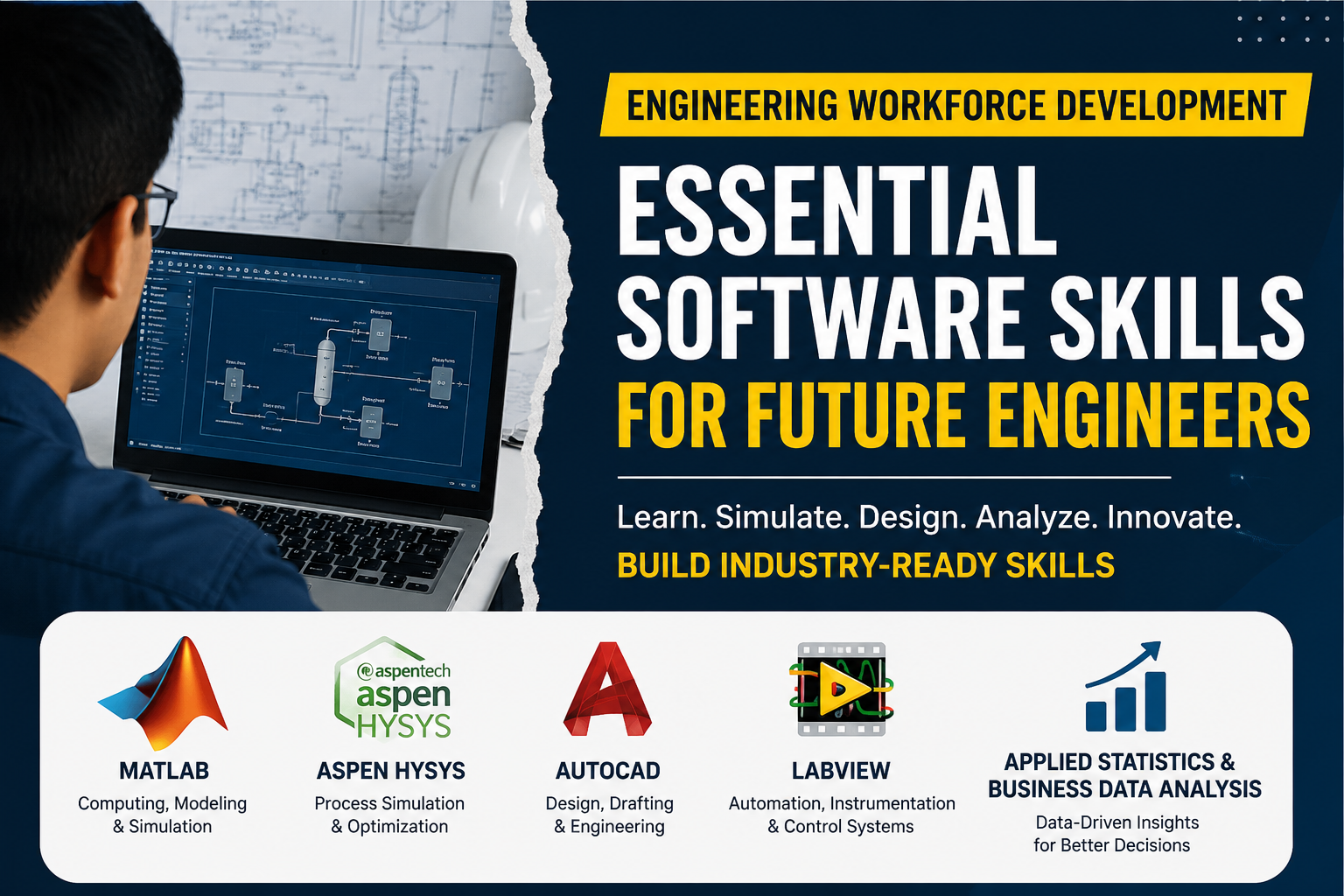
One of the most valuable platforms for engineers is MATLAB, widely used for numerical computing, algorithm development, engineering simulations, machine learning, signal processing, control systems, and data visualization. Students who develop MATLAB skills gain hands-on experience in solving real-world engineering problems while preparing for careers in research, product development, and industrial automation.
For chemical, petroleum, and process engineers, Aspen HYSYS remains one of the industry’s leading process simulation tools. Engineers use Aspen HYSYS to design chemical plants, optimize production processes, improve energy efficiency, evaluate process safety, and reduce operational costs before physical implementation. As industries continue prioritizing sustainability and process optimization, simulation software has become an indispensable engineering skill.
Design accuracy is equally important across engineering disciplines. AutoCAD enables engineers to create precise technical drawings, manufacturing layouts, piping diagrams, plant designs, and construction documentation that comply with international engineering standards. Employers consistently seek graduates who can transition from conceptual ideas to production-ready engineering drawings using professional CAD software.
Industry 4.0 has also accelerated demand for automation expertise. LabVIEW provides engineers with the ability to build automated testing systems, collect real-time sensor data, control instrumentation, and develop monitoring solutions for manufacturing and research environments. These capabilities are increasingly valuable in smart factories, robotics, industrial IoT, and advanced laboratory applications.
Modern engineering also requires strong analytical thinking supported by Applied Statistics and Business Data Analysis. Engineers today work with large datasets to improve quality control, optimize production, predict equipment failures, and support business decision-making. Professionals who combine technical engineering knowledge with data-driven analysis are better positioned for leadership roles across multiple industries.
Governments across North America continue investing heavily in engineering workforce development. The NSF Advanced Technological Education (ATE) Program supports colleges and institutions that prepare highly skilled technicians for advanced manufacturing, engineering technologies, and emerging industries. Explore the program here: https://www.nsf.gov/funding/opportunities/ate-advanced-technological-education.
Similarly, the Government of Canada is investing in advanced manufacturing, clean technology, engineering innovation, and digital skills through Innovation, Science and Economic Development Canada. Learn more at https://ised-isde.canada.ca/.
For engineering students and working professionals, mastering platforms such as MATLAB, Aspen HYSYS, AutoCAD, LabVIEW, and engineering data analytics is no longer simply an additional qualification—it has become a competitive advantage. Practical software expertise demonstrates industry readiness, strengthens technical problem-solving capabilities, and prepares engineers to contribute immediately in modern engineering environments where digital engineering and computational technologies continue to reshape the future.